
The dangers of 19th century schools
We often look back at the past as an alien and unfamiliar time period, when horses walked the streets of Christchurch instead of cars and light was supplied by lamps and candles instead of lightbulbs. I recently had the opportunity to research an archaeological site in Christchurch – the old librarian’s house that used to be located on Cambridge Terrace before it was demolished after the earthquake – and whilst looking through the collection of artefacts that were discovered in the site’s 2012 excavation, I stumbled down a rabbit hole that showed me that we may be more similar to the people of 19th century New Zealand than we may think.
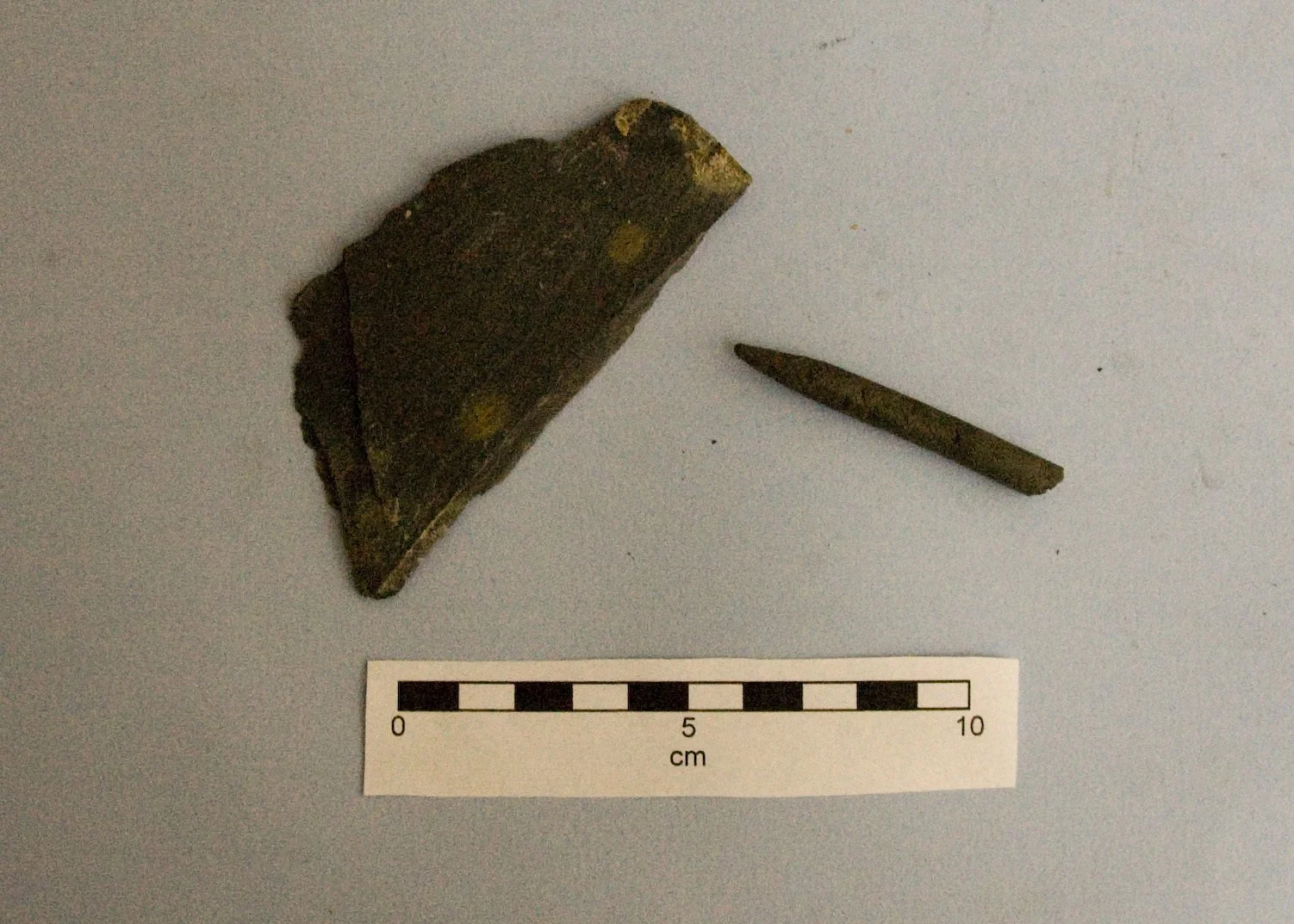
The writing slate and slate pencil found at the site of the librarian’s house in Cambridge Terrace, Christchurch. Image: Ōtautahi Christchurch archaeological archive.
I came across a piece of slate and a slate pencil. Slate is a type of clay-rich rock that easily splits into thin, flat slabs and was used in 19th century New Zealand as a medium for schoolwork – just as we today write out our work with pen and paper or on a computer (Davies, 2005: 63). Using a slate pencil, children could use the slate to write, draw and do calculations (Nelson Evening Mail, 02/07/1869: 2). The history of slate in education far exceeds the 19th century; whilst its main production period was between 1770 to 1900, there is evidence of it being used well before this time, and many schools in New Zealand continued to use it until the 1950s, when it began to become less popular as paper became cheaper (Davies, 2005: 63). Many people in the country today will remember using slate in school! Whilst this seems similar enough to our own schooling mediums – the slate having great similarities to a whiteboard or blackboard – upon investigating further, I discovered that their use was also seen as somewhat dangerous...
Certain diseases were far more widespread and dangerous in the 1800s compared to today. Modern medicine has allowed for the threat of many to be minimised, if not eradicated, through the development of vaccines and deepening of our understanding surrounding how they spread (Das, Baker and Calder, 2006: 17-28). In the 19th century, slates were seen as a risk for the spread of life-threatening diseases such as tuberculosis and diphtheria (Davies, 2005: 66). This is because they were passed amongst children who would typically clean the slates using saliva on their fingers or put the pencils in their mouths as they worked, spreading infections to the next user of the tools through contact. By the late 19th century, many concerned public health officials and parents in New Zealand and Australia were putting pressure on the school system to remove slates from the classroom, or at the very least implement better hygiene policies surrounding their use to minimise the risk of infection (Davies, 2005: 66). As a result, over time the slate’s popularity in schools began to decline.
In one of a series of popular health lectures recently delivered at Perth, Dr. Ferguson drew attention to a very common practice among school children which may affect the spread of tuberculosis. He says that, in certain schools, slates are handed to the children, and that there is not the slightest attempt made to ensure that each child shall have the same slate time after time. Now the first thing the child does is to clean the slate, which is done in a primitive method, by means of the finger wetted with saliva. In this process the finger travels many times from mouth to slate, and vice versa, and thus conveys to the mouth any material which may happen to be upon the slate. What this material may be depends largely on the health of the child who previously used the slate. Dr. Ferguson’s special point was that tuberculosis might thus be transmitted from child to child; but it is even more obvious that such a disease as diphtheria might be diffused in this manner.
Press, 04/06/1895: 6
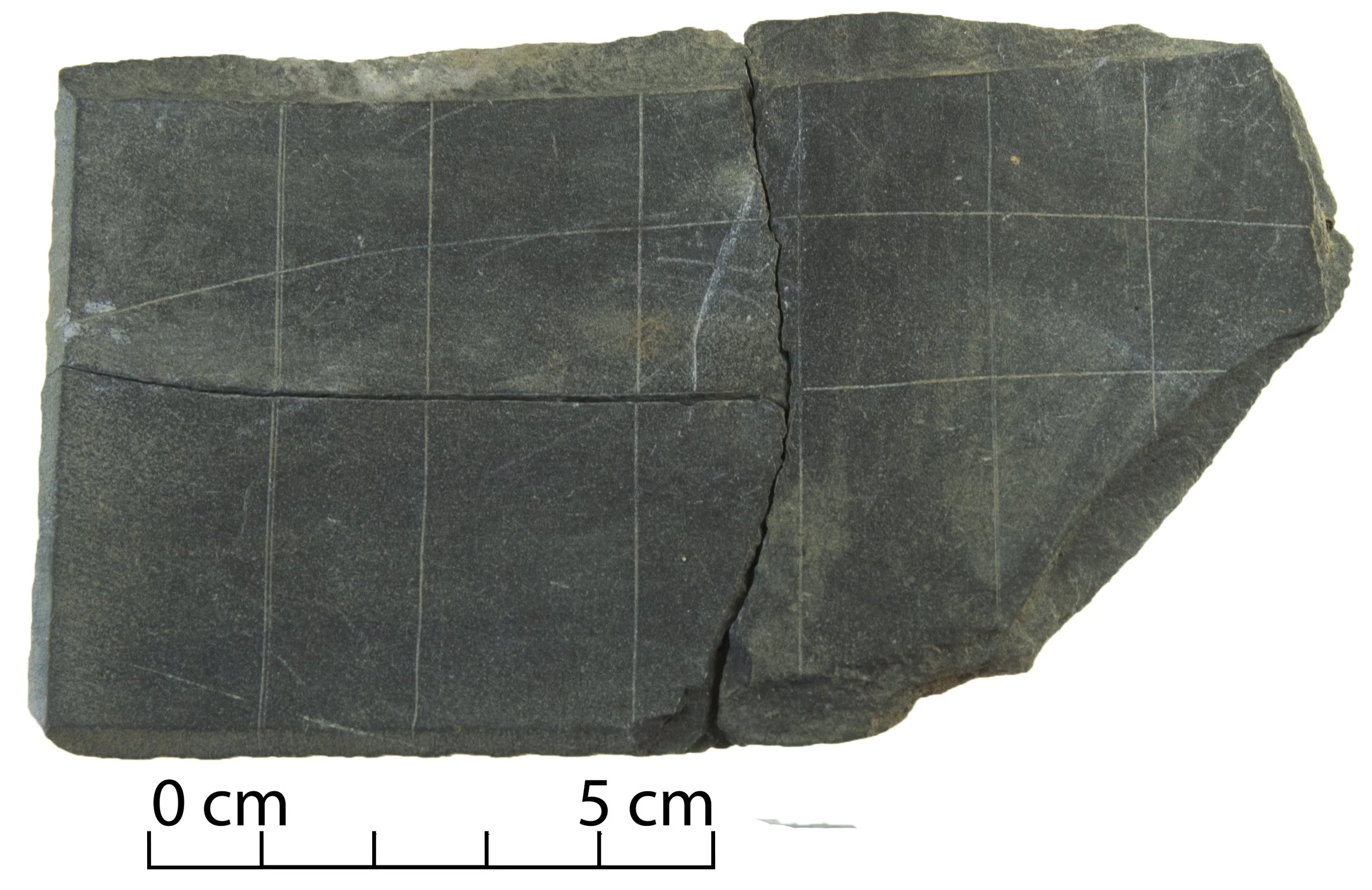
A writing slate found during archaeological work at Te Pae. Image: J. Garland, Ōtautahi Christchurch archaeological archive.
My first reaction to reading these articles was surprise to learn that such a seemingly normal object carried an abnormally dangerous element, but then I started to feel a sense of familiarity. I personally was a high school student at the time that Covid 19 began and spent long periods of my final years of schooling at home in quarantine as opposed to in the classroom, just as many others of my generation in the country – and the rest of the world – did. Even when I returned to school, I vividly remember the worries of the spread of the virus expressed by my peers and their parents. Regulations were put in place to minimise the risk, such as disinfecting surfaces and teaching mediums such as whiteboards.
We are over a hundred years in the future and have seen incredible advances in both the health and education systems, so I was shocked to realise that the fears and concerns expressed by students and parents of the 19th century resonated so strongly with our own today. I feel it goes to show that whilst society and its systems have changed, and in many ways with it so have people, there are some things which have not.
Erica Borthwick
References
Das, D., Baker, M. and Calder, L., 2006. ‘Tuberculosis Epidemiology in New Zealand: 1995–2004.’ The New Zealand Medical Journal, Vol. 119, 17-28.
Davies, P., 2005. ‘Writing Slates and Schooling.’ Australasian Historical Archaeology, Vol. 23, 63-69.
Nelson Evening Mail. Available online at: https://paperspast.natlib.govt.nz/
Press. Available online at: https://paperspast.natlib.govt.nz/